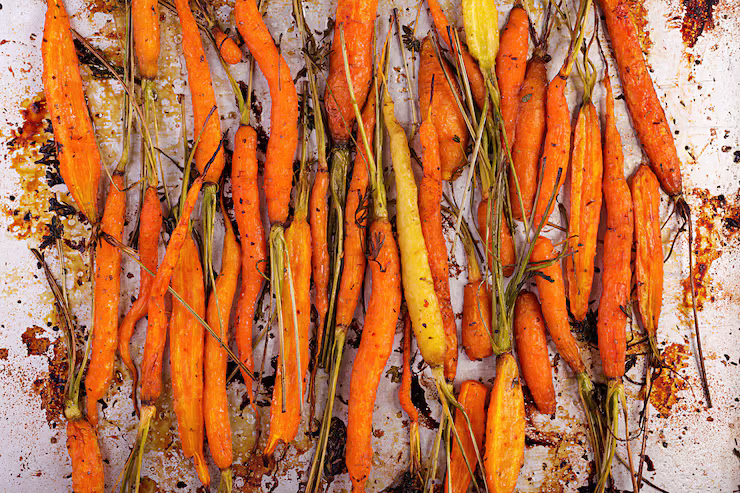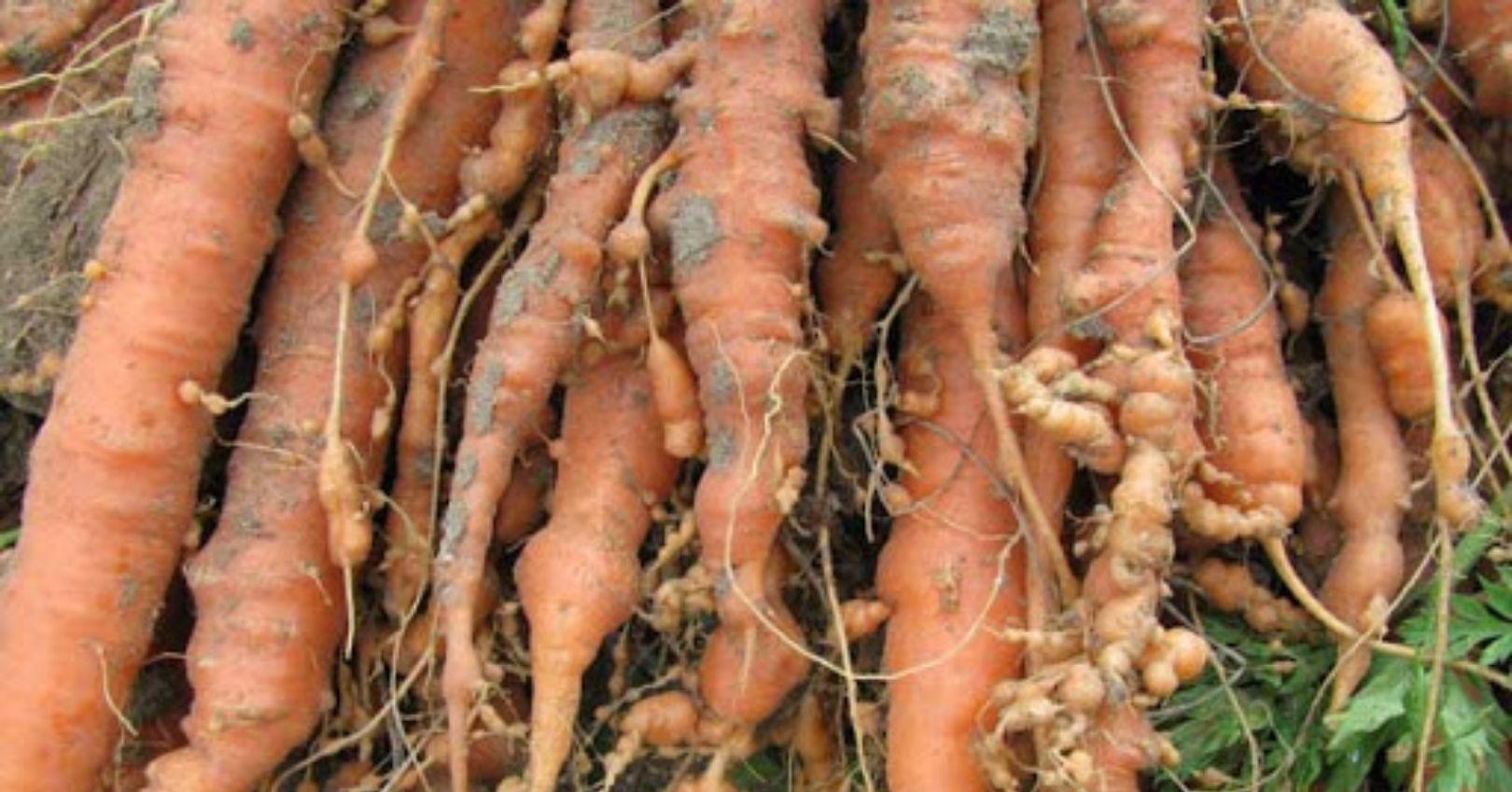

You're examining your carrot crop on a humid August morning. At first, you notice just a few brown spots on the lower leaves. By the next week, those spots have multiplied. Two weeks later, the entire canopy is spotted, yellowing, and dying back. The carrots themselves are still developing, but you know something is seriously wrong. Welcome to leaf blight, the disease that destroys more carrot crops than anything else, yet most growers don't see it coming until it's too late.
Carrot diseases attack when you least expect them and spread fast once they start. The frustrating part is that many diseases are preventable through knowledge and early action, yet most growers discover problems only after significant damage has occurred. Understanding what causes carrot diseases, recognizing early symptoms, and implementing proven control strategies transforms disease from a crop killer into a manageable challenge.
If disease is already affecting your carrot crop, Plantlyze's AI plant diagnostic tool can identify the exact pathogen from leaf photos in seconds, giving you specific treatment recommendations rather than forcing you to guess.
Understanding Carrot Diseases: The Fundamentals
Carrot diseases typically fall into three categories based on how they spread: seedborne pathogens living in or on seeds, soilborne pathogens in the soil, and vector-borne pathogens spread by insects. Understanding which category affects your crop determines whether you're fighting a problem that's already arrived or preventing one that hasn't.
Environmental conditions create disease-promoting situations. Warm, wet weather combined with poor air circulation creates ideal conditions for fungal diseases. Overhead irrigation that keeps foliage wet for hours extends the infection window. Cool, wet soils with poor drainage favor root diseases. Leafhopper-vectored diseases thrive when insect populations are high. Most growers can't prevent weather, but they can manage irrigation methods, spacing, air circulation, and cultural practices.
Seedborne diseases pose a unique challenge. A pathogen living inside or on seed remains hidden until it infects the growing plant. Disease-free or Alternaria-indexed seed is foundational to disease prevention. Saving seed from your own crop guarantees disease perpetuation unless you implement seed treatment protocols. Commercial seed from reputable suppliers significantly reduces seedborne disease risk.
Leaf Blight Diseases: The Primary Threat
Alternaria and Cercospora leaf blights are the most economically damaging carrot diseases in North America, and they're also the most common ones growers encounter. Both are fungal diseases favored by warm weather, humidity, and overhead irrigation. Once established in a field, they spread relentlessly through spores landing on healthy foliage.
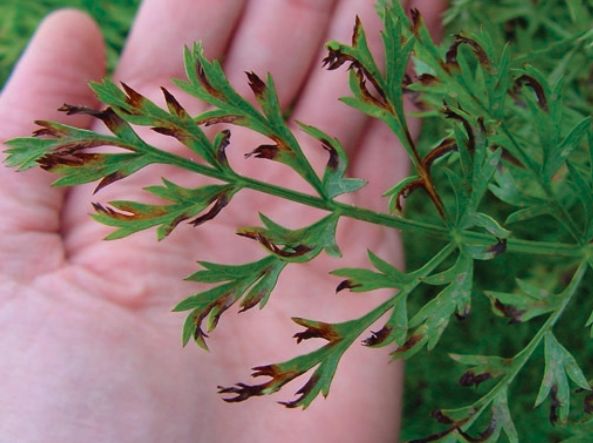
Alternaria leaf blight starts with dark brown lesions on leaf margins, creating a distinctive pattern where browning begins at the leaf edges and progresses inward. The lesions enlarge and may show concentric rings. Severe infections cause rapid defoliation, exposing developing carrots to sunscald. Alternaria also causes a secondary disease called black rot that affects both crowns and roots.
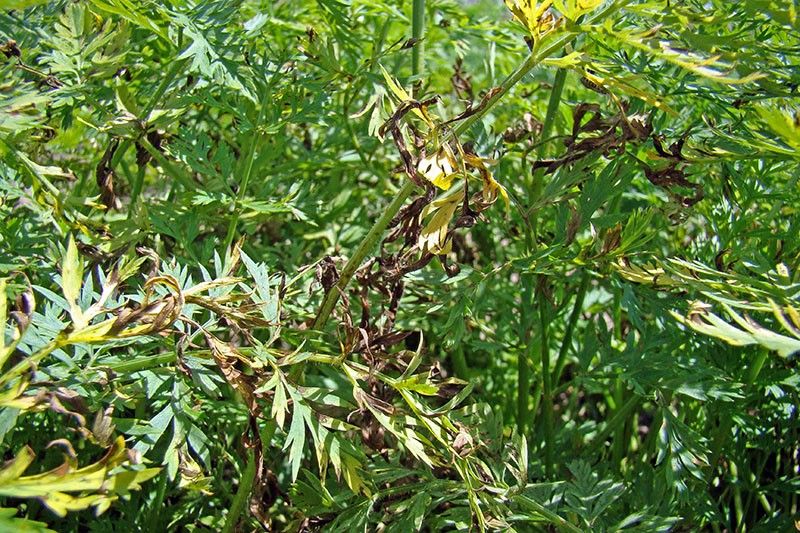
Cercospora leaf blight appears as small circular tan to brown lesions surrounded by a chlorotic (yellow) halo, particularly on younger leaves. As the disease progresses, leaf margins curl and entire leaflets yellow. Lesions on stems and petioles are elliptical and dark brown. Under heavy pressure, severe foliage loss occurs and yields plummet.
Both diseases are seedborne. The fungi overwinter on plant debris and in soil. High relative humidity (above 85%) combined with temperatures between 60-80°F create perfect infection conditions. Rain or overhead irrigation that keeps foliage wet for 12 or more hours dramatically increases infection risk. Compact plantings with poor air circulation trap humidity inside the canopy, creating a microclimate where fungal diseases thrive.
The treatment threshold for fungicide application is when 25% of sampled leaves show lesions. This doesn't mean waiting until you notice disease spread across the entire field. Scout plants weekly, especially susceptible varieties. Collect 50 leaves from random plant locations in your carrot field. If any of those leaves show lesions on the leaf blade or petiole, fungicide treatment is justified.
Disease-resistant varieties dramatically reduce fungicide needs and disease severity. Apache, Bolero, Caro-choice, Caropak, Cellobunch, Early Gold, Enterprise, Kuroda, Magnum, Nevis, and SugarSnax 54 all show strong resistance to both Alternaria and Cercospora. On resistant varieties, disease appears later in the season and spreads more slowly. Losses are lower and you'll need fewer fungicide applications.
Fungicide options include copper hydroxide (organic acceptable), chlorothalonil, azoxystrobin, penthiopyrad, and boscalid/pyraclostrobin combinations. Copper hydroxide requires application every 7 to 14 days. Chlorothalonil applies at 7 to 10 day intervals. Strobilurin fungicides like azoxystrobin and trifloxystrobin require rotation with different modes of action to prevent resistance. Begin applications before disease appears in susceptible varieties. Continue every 7 to 14 days depending on disease pressure and weather conditions.
Cavity Spot and Root Diseases: The Hidden Problem
Cavity spot, caused by Pythium species, appears as small sunken lesions on carrot taproots. These lesions are elliptical or irregular, usually less than 0.5 inch in diameter, though they can be larger on processing varieties. The lesions cluster on the upper third of the root and darken as carrots mature. Infected carrots are unmarketable because consumers assume the disease spread throughout the root.
Cavity spot thrives in cool soils and conditions of excessive moisture. The disease develops in poorly drained fields, during rainy springs, or when irrigation is excessive. Pythium spores exist in almost all soils, but disease only develops under waterlogged conditions. Unlike fungal leaf diseases you can control with fungicides, cavity spot requires environmental management.
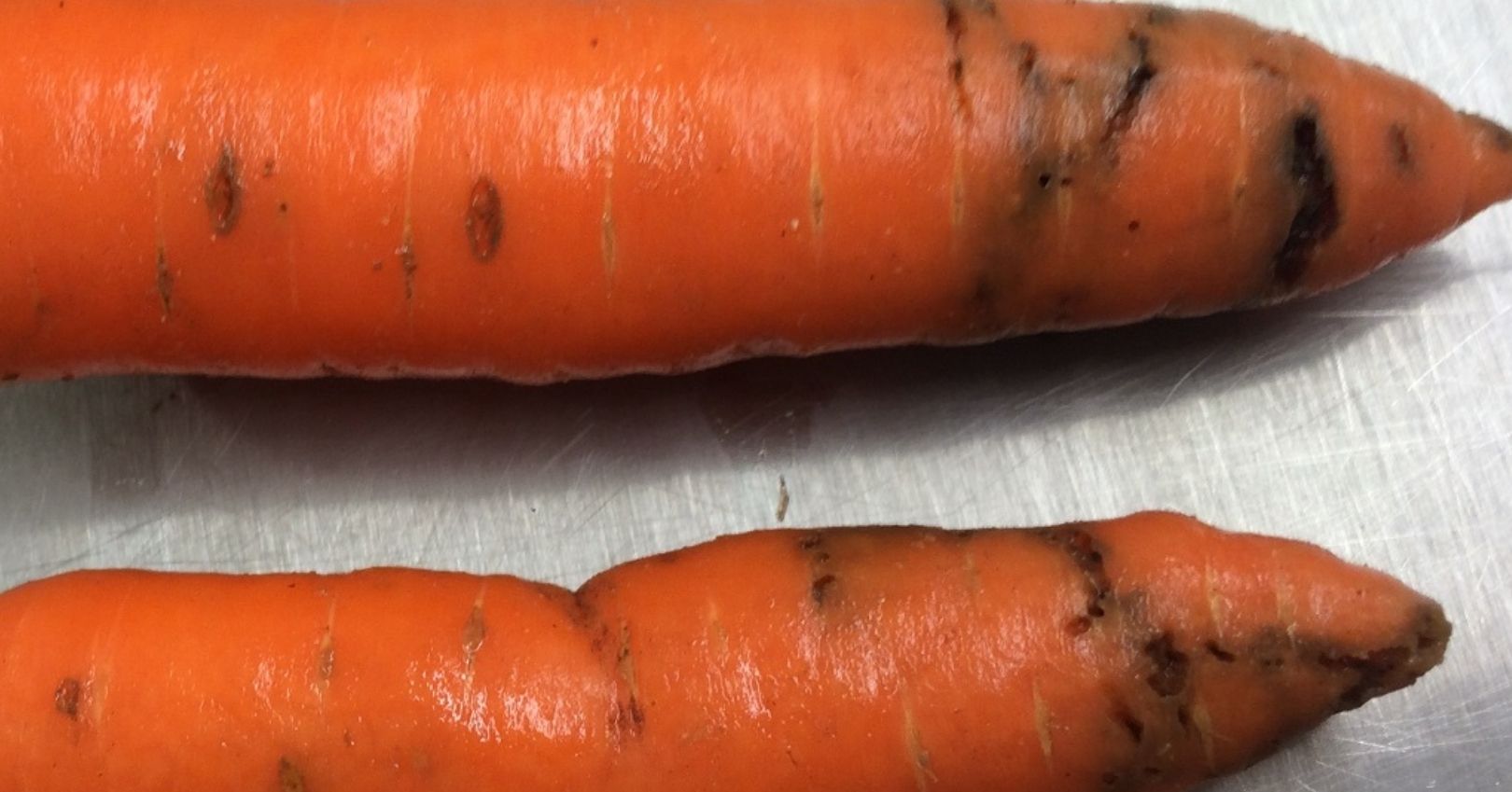
The best cavity spot control is a 3 to 4 year crop rotation to non-host crops. Never plant carrots in the same field more frequently than every fourth year. Improve drainage in low-lying areas and avoid over-irrigation. Harvest soon after carrots reach maturity because older carrots are more susceptible to infection. Maintain soil pH between 6.5 and 7.0 because high pH suppresses disease development.
Black rot, caused by Alternaria radicina, attacks the crown where petioles attach. Black lesions develop on the crown base and extend downward into the root, creating the characteristic black discoloration. The fungus is seedborne, making seed treatment critical. Plant only Alternaria-indexed seed or treat seed in a hot water dip at 122°F for exactly 25 minutes. Treat longer and you damage the seed's viability.
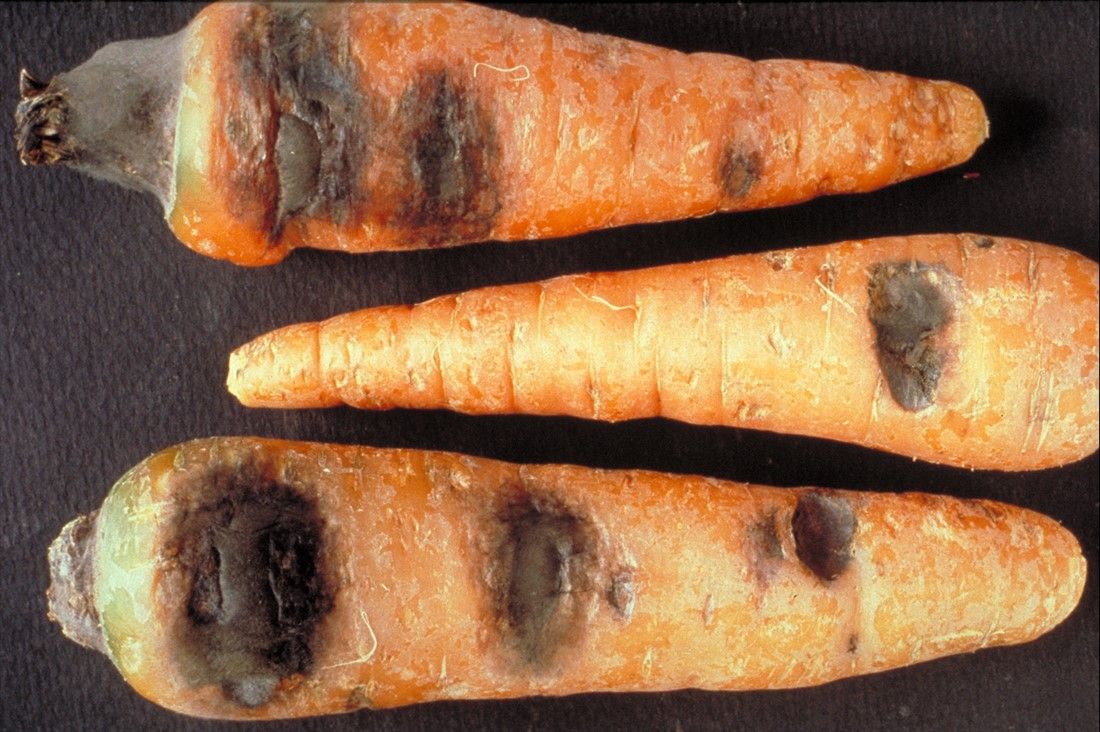
Black root rot (Thielaviopsis basicola) is primarily a post-harvest disease, though it can develop late in the growing season. This fungus is worldwide in distribution and affects many crops. Once harvested, infected carrots show black lesions on the root surface. Discard any harvested carrots showing visible symptoms. Avoid planting in soil where black root rot occurred for several years.
Aster Yellows: The Viral-Like Disease You Can't Cure
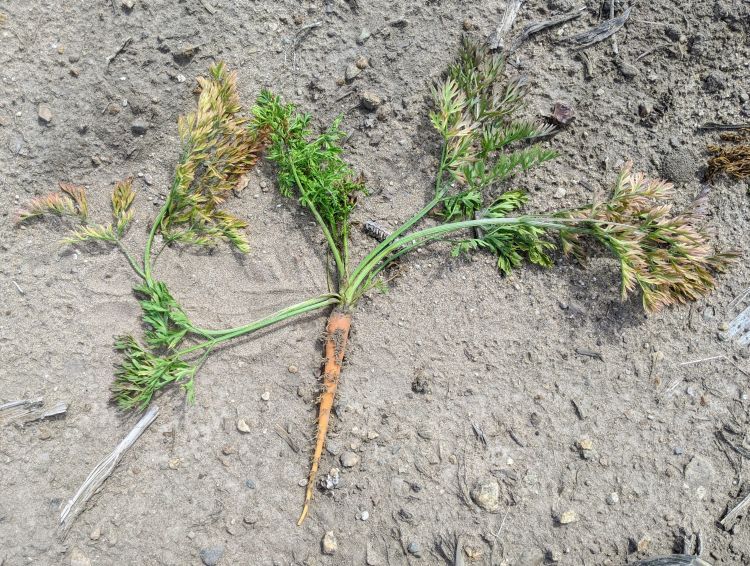
Aster yellows is a unique disease because it's caused by a phytoplasma, a bacterium-like organism that's neither quite a bacterium nor quite a virus. The disease is vector-borne, meaning leafhoppers transmit it from plant to plant. Unfortunately, there is no cure for aster yellows. Once a plant is infected, it remains infected. Your only option is immediate removal and disposal.
Symptoms appear as yellowing of foliage, resetting of leaves toward the center of the plant, and stunting of overall growth. Infected carrots are severely undersized and unmarketable. The disease affects hundreds of plant species, making it impossible to eradicate from your growing region.
The key to aster yellows management is preventing leafhopper infection. The primary vector, Macrosteles quadrilineatus, can transmit the phytoplasma with a single probe into plant tissue. Use floating row covers over your carrot crop to exclude leafhoppers entirely. This is the most effective management method. Reflective or light-colored mulches around plants also deter leafhoppers by confusing their vision. Remove nearby weeds like dandelions that can host the disease and serve as virus reservoirs.
If leafhoppers are present despite prevention efforts, insecticide treatment becomes necessary. However, by the time you detect significant leafhopper populations, some transmission has likely already occurred. Prevention is far superior to treatment.
Resistant Varieties: Your First Line of Defense
Variety selection is arguably the most important disease management decision you make. Growing disease-resistant carrots eliminates the need for fungicide sprays entirely or dramatically reduces them. Resistant varieties are available for most major carrot diseases.
For leaf blights, resistant varieties include Apache, Bolero, Caro-choice, Caropak, Cellobunch, Early Gold, Enterprise, and Kuroda. These varieties maintain green, healthy foliage while susceptible varieties defoliate. For black rot protection, use Alternaria-indexed seed from reputable suppliers and plant disease-resistant varieties. For cavity spot resistance, Stefano and Navarre show improved tolerance compared to other varieties.
When selecting varieties, also consider their suitability for your region and season. Some varieties produce best in cool spring weather while others tolerate summer heat. Check with your local university extension office for variety recommendations specific to your climate and the diseases prevalent in your area. A heat-loving, disease-tolerant variety that thrives in summer conditions beats a susceptible variety that struggles in your climate.
Preventive Disease Management: The Complete Protocol
Rather than fighting diseases once they appear, implementing preventive management systems keeps problems from developing in the first place. This approach is more economical, produces cleaner crops, and requires less labor than managing active disease outbreaks.
Scout your carrot crop every week, especially after rain or periods of high humidity. Walk through fields or gardens systematically. Examine lower leaves where early disease symptoms appear. Look for brown lesions, yellowing halos around spots, curled leaf margins, or other abnormalities. Take photos of suspicious symptoms on your phone. The earlier you detect disease, the sooner you can respond.
Manage irrigation to minimize disease pressure. Drip irrigation that delivers water directly to soil is far superior to overhead irrigation for disease management. Overhead irrigation keeps foliage wet for extended periods, creating ideal conditions for fungal spore germination. If overhead irrigation is necessary, water early in the morning so foliage dries quickly as temperatures rise.
Spacing and air circulation prevent humidity buildup within the canopy. Crowded plants trap humid air, creating a microclimate where fungal diseases flourish. Maintain proper spacing and thin seedlings to final stand as directed on seed packets. Good air movement dries foliage quickly after rain or irrigation, restricting fungal infection windows.
Crop rotation is essential for soilborne and seedborne disease management. Never plant carrots in the same location more frequently than every 3 to 4 years. Rotate to unrelated crops like beans, lettuce, tomatoes, or other vegetables. This allows soilborne pathogens to die off or become diluted in the soil. Seedborne diseases are naturally controlled through crop rotation because the pathogen has no host plant to infect.
Sanitation practices remove inoculum from fields before disease starts. Remove crop residue immediately after harvest by pulling or plowing. Don't leave carrot tops or roots in the field where fungi can overwinter. Disinfect tools between plants if hand-harvesting, especially if disease is present. Keep field margins free of wild carrots and related weeds that can harbor disease pathogens and vectors.
Using Technology for Early Diagnosis
Modern plant diagnostic tools solve a critical problem: identifying which disease is affecting your carrots before visible symptoms become obvious. Plantlyze's AI analysis identifies specific pathogens from leaf photos, eliminating guesswork about whether you're dealing with Alternaria, Cercospora, Pythium, or a different pathogen. You get specific fungicide recommendations matched to the exact disease rather than spraying broad-spectrum fungicides hoping something works.
Early detection accelerates your response timeline. When caught at early stages, disease is far easier to control and less damaging to yields. Unsure if your leaf spots indicate a serious problem or benign stress, upload a photo to Plantlyze and get answers in seconds.
Conclusion: Building Long-Term Disease Management
Carrot disease management isn't about fighting a single disease. It's about building an integrated system combining resistant varieties, preventive cultural practices, early detection, and targeted fungicide applications when disease appears. The most successful growers don't wait for obvious disease to appear. They scout regularly, identify problems early, and intervene decisively.
Your action plan starts now. Select disease-resistant varieties matched to your climate and season. Implement proper spacing and irrigation to reduce humidity. Scout regularly and photograph suspicious symptoms. Practice 3-4 year crop rotation. If disease appears, identify it precisely before applying fungicides. This systematic approach builds healthier crops, reduces disease pressure over seasons, and positions your operation for long-term success.
Don't guess about carrot diseases. Visit plantlyze.com and upload photos of affected leaves to get instant identification and treatment recommendations tailored to your specific situation. Whether you're dealing with leaf blights, root diseases, or vector-borne pathogens, early and accurate diagnosis makes all the difference in protecting your crop.
References
1. UC IPM (2024) – Cavity Spot / Carrot / Agriculture
https://ipm.ucanr.edu/agriculture/carrot/cavity-spot/
2. UC IPM (2024) – Black Rot (Black Crown) / Carrot / Agriculture
https://ipm.ucanr.edu/agriculture/carrot/black-rot-black-crown/
3. UC IPM (2024) – Cercospora Leaf Blight / Carrot / Agriculture
https://ipm.ucanr.edu/agriculture/carrot/cercospora-leaf-blight/
4. Cornell University (2024) – Carrot Leaf Blight Diseases and Their Management
https://www.vegetables.cornell.edu/pest-management/disease-factsheets/carrot-leaf-blight-diseases-and-their-management/
5. Rutgers University – Controlling Fungal Leaf Blights of Carrot
https://plant-pest-advisory.rutgers.edu/controlling-fungal-leaf-blights-of-carrot-2/
6. Wisconsin University – Carrot Alternaria and Cercospora Leaf Blights
https://vegpath.plantpath.wisc.edu/diseases/carrot-alternaria-and-cercospora-leaf-blights/