

Introduction
Your carrot crop looks healthy one moment, then suddenly the leaves start yellowing, roots become stunted, or worse, internal root damage appears that you only notice at harvest. Nutrient deficiencies are one of the most overlooked yet preventable reasons farmers lose substantial portions of their carrot yield to unmarketable roots and reduced quality.
The economic impact is significant. A single nutrient deficiency can reduce your marketable yield by 25 to 40 percent, turning healthy looking plants into crops worth significantly less at market. The challenge isn't just identifying that a problem exists. It's knowing exactly which nutrient is missing and how to correct it before harvest loss compounds.
This comprehensive guide walks you through identifying every major nutrient deficiency that affects carrots, understanding why it happens, and implementing solutions that work. By the end, you'll have a clear framework for diagnosing what your carrots need and fixing it fast.
Why Identifying Nutrient Deficiencies Early Protects Your Harvest
Carrot crops face a critical window. Once a nutrient deficiency becomes visible in the leaves, the damage to root development has already begun. Unlike leafy greens where you harvest the foliage, carrots demand perfect root quality to be marketable. A cavity on the root surface, internal cracking, or stunted root size means that carrot is worthless at harvest regardless of what the plant looks like above ground.
Early detection changes everything. When you catch a nitrogen deficiency in week 3 of growth, a quick fertilizer application reverses the yellowing within days and roots continue developing normally. When you catch the same deficiency in week 8, the damage is already done. Roots never catch up to their full potential size and quality.
The economic argument is straightforward. Preventing nutrient deficiencies through soil testing costs 20 to 40 dollars per acre. Fixing established deficiencies costs significantly more and doesn't always completely reverse damage. In regions with sandy soils where nutrient leaching is severe, the difference between a proactive nutrient management program and reactive fixes is often the difference between profitable and break-even seasons.
Carrots also have specific regional vulnerabilities. Sandy soils in many growing regions drain quickly, causing rapid nitrogen leaching, particularly after heavy rainfall. Alkaline soils in other areas lock up boron and other micronutrients, making them unavailable despite being present in the soil. Understanding these geographic patterns helps you anticipate problems before they start.
The Role of Key Nutrients in Carrot Growth
Every nutrient your carrots need falls into one of two categories: macronutrients that plants need in large quantities, and micronutrients required in smaller amounts but just as critical for growth.
The movement of nutrients through the plant matters enormously for diagnosis. Mobile nutrients like nitrogen, potassium, and magnesium move freely through the plant whenever conditions allow. When these nutrients run low, the plant moves them from older leaves to newer leaves where growth is happening. This is why nitrogen deficiency always appears in older leaves first. The plant is essentially taking nitrogen from the old leaves to feed the new ones.
Immobile nutrients like calcium and boron cannot move once they've been placed in a leaf or root. When these nutrients are deficient, symptoms appear on young leaves and roots first because that's where the nutrient runs out. This distinction is your first clue when diagnosing what's wrong.
Micronutrients like boron, iron, and manganese don't get enough attention until deficiency strikes. Yet they control critical functions that prevent other problems. Boron, for instance, is essential for calcium utilization. Without adequate boron, you develop calcium deficiency symptoms even in soils with plenty of calcium present.
Soil pH affects nutrient availability more than most farmers realize. A neutral pH between 6.5 and 7.0 makes most nutrients available for root uptake. Acidic soils below pH 5.5 can lock up phosphorus and molybdenum. Alkaline soils above pH 7.5 lock up micronutrients like boron and iron. Your soil might contain plenty of nutrients, but if the pH is wrong, they're completely unavailable to your carrots.
Water movement through soil directly transports only calcium and boron. Other nutrients move through the soil but aren't carried as efficiently. Carrots going through drought stress might show calcium deficiency symptoms not because calcium is missing, but because drought stops the water movement that transports calcium into roots.
Nitrogen Deficiency: Stunted Growth and Yellowing Leaves
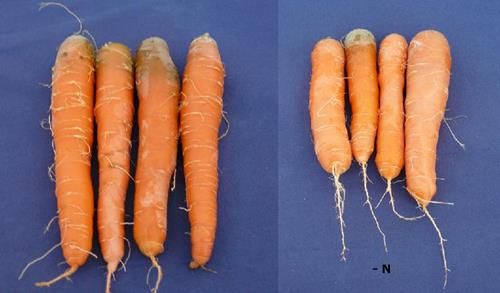
Nitrogen is the nutrient carrots demand most heavily, and it's also the most mobile in soil, making it the most commonly deficient nutrient in carrot production.
When nitrogen runs low, older leaves become pale green first, then progress to obvious yellowing. You'll notice the yellowing starts at leaf margins and spreads inward. Eventually older leaves develop red tints and brown necrotic spots before dropping entirely. The entire plant looks weak and thin. Leaf size shrinks, and the number of leaves visible on each plant noticeably decreases.
Root symptoms are equally telling. Carrots experiencing nitrogen deficiency fail to develop thick, robust taproots. Instead, roots become thin and fibrous. Root length stays stunted compared to adequately fertilized plants. The overall effect is a plant that looks like it hasn't grown in weeks even if months have passed.
Nitrogen deficiency typically occurs in three scenarios. Sandy soils with heavy rainfall experience nitrogen leaching where nitrates wash past root zones into groundwater. Soils low in organic matter lack the slow nitrogen release that compost and manure provide. Inadequate initial fertilizer application or missed follow up applications during the growing season cause progressive deficiency as plants consume available nitrogen.
Fixing nitrogen deficiency requires understanding timing. A single large nitrogen application creates risk. Heavy nitrogen late in the season pushes excessive leaf growth while roots suffer. The better approach is split applications. Apply base nitrogen before planting, then follow with light nitrogen applications every 2 to 3 weeks during the growing season. This keeps nitrogen available when the plant needs it most.
Organic sources take longer to work but provide steadier nitrogen release. Aged compost added at 5 to 10 tons per acre supplies nitrogen plus organic matter. Well decomposed manure provides similar benefits. For faster correction of severe deficiency, urea applied at 50 to 100 pounds per acre per application works within days. Foliar sprays of urea at 10 grams per liter work even faster, showing leaf color improvement within a week, though this is temporary without addressing soil nitrogen.
The distinction between temporary symptom fix and actual correction matters. Foliar spray makes yellowing leaves green again quickly, but those leaves won't grow larger. Soil applied nitrogen that continues feeding the plant through the season allows new growth to be normal sized with healthy color.
Phosphorus Deficiency: Poor Root Development and Purple Leaves
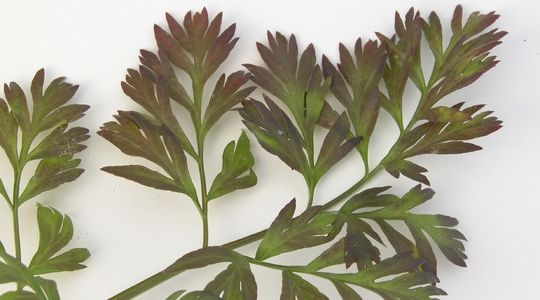
Phosphorus deficiency rarely causes severe problems in most growing regions, but when it does appear, the symptoms are distinctive and the consequences for root development are serious.
When phosphorus availability drops, older leaves develop purple or reddish discoloration, particularly along the leaf margins. Unlike nitrogen deficiency, no yellowing occurs. The plant growth slows noticeably. Roots fail to develop adequate branching. Root size stays stunted. Plant maturity delays, stretching your harvest window and tying up land longer than planned.
Phosphorus deficiency typically indicates broader soil management problems. Highly acidic soils below pH 5.5 bind phosphorus into forms roots cannot access. Cool, wet spring soils slow phosphorus uptake even when phosphorus is present. Clay soils with poor drainage create conditions where phosphorus remains unavailable.
Prevention works better than correction for phosphorus. Pre plant soil testing identifies phosphorus status before planting. Applying phosphorus fertilizers before planting ensures availability throughout the season. Single superphosphate applied at 100 to 200 pounds per acre provides quick acting phosphorus. Bone meal or rock phosphate at 1 to 2 tons per acre provides slower but longer lasting phosphorus.
Correction once deficiency appears requires multi-pronged approach. Check soil pH and adjust if needed. Phosphorus becomes readily available in the 6.2 to 7.0 pH range. Adding phosphorus solubilizing bacteria along with organic matter helps existing phosphorus become available. Biofertilizers improve phosphorus availability over time while traditional fertilizer fixes the immediate shortage.
Potassium Deficiency: Leaf Scorch and Weak Plants
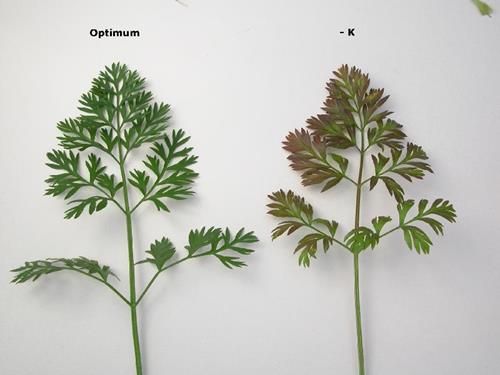
Potassium deficiency typically appears midseason when plant demand peaks. The distinctive symptoms make it easy to identify once you know what to look for.
Older leaves develop reddish discoloration starting at the margins. This progresses to brown scorching of leaf edges. Affected leaf margins curl backward in a cupped appearance. Eventually entire leaf margins turn yellow brown before necrosis sets in and leaves drop. Violet streaks may appear on roots beneath the soil surface.
Root quality suffers dramatically. Potassium deficient carrots develop weak, smaller roots. A carrot that should weigh one pound at harvest weighs half that. Sweetness decreases and storage quality declines. The problem compounds because weak roots are more susceptible to disease, leading to additional losses at harvest.
Potassium deficiency most commonly appears in three situations. Sandy soils naturally low in potassium leach this nutrient rapidly. Excessive nitrogen application creates nutrient imbalance, encouraging plant uptake of nitrogen over potassium, even when potassium is adequate. Cool season springs slow potassium uptake into roots even when soil potassium is sufficient.
Quick fixes for potassium deficiency begin with foliar spray. Sulphate of potash sprayed at 10 grams per liter of water applied in early morning provides rapid symptom improvement. Plants absorb potassium directly through leaves within hours. This doesn't solve the root problem but prevents further deficiency symptoms while soil applied fertilizer works.
Soil applied potassium sulfate at 50 to 100 pounds per acre addresses the underlying shortage. Avoid muriate of potash in irrigated fields because the chloride content increases soil salinity. Organic sources like wood ash at 2 to 4 tons per acre provide potassium plus trace minerals. Seaweed products supply potassium along with growth promoters that improve overall plant vigor.
Maintaining soil pH above 6.0 ensures potassium remains available. Adding organic matter through compost incorporation improves potassium retention in soil. Split potassium applications work better than single large applications because potassium availability for uptake increases throughout the season.
Calcium Deficiency: Cavity Spot and Root Cracking

Calcium deficiency creates the most devastating visible damage to carrot roots. Cavity spot disorder, characterized by depressed lesions on root surface, directly reduces marketability and is the primary concern with calcium deficiency.
Above ground symptoms are less obvious. Young leaves show scorching and necrosis at the growing tips. New leaves develop ragged, brittle margins. Leaves may wither or show reduced internodal length creating a rosetting appearance. Overall plant stunting occurs, but the real damage happens underground where you can't see it until harvest.
Root damage from calcium deficiency includes reduced root size, severely stunted growth, and localized tissue collapse that appears as cavity spots. These external lesions create entry points for pathogenic fungi and bacteria, particularly Pythium species that cause rotting. A calcium deficient carrot might look acceptable at harvest, then rot within weeks in storage.
Calcium deficiency develops through several mechanisms. Irregular watering or drought stress interrupts water movement, and calcium is the only nutrient that moves primarily through water transport in the plant. Extremely acidic soils below pH 4.5 create calcium unavailability. Paradoxically, high phosphorus levels compete with calcium uptake. Boron deficiency prevents calcium utilization even when calcium is present. High humidity in field conditions can prevent transpiration, which is the driving force moving calcium into root systems.
Prevention through consistent moisture management is critical. Carrots need steady soil moisture, not wet then dry cycles. Drip irrigation delivering consistent water throughout the season prevents the water stress that blocks calcium transport. Soil pH management keeping pH in the 6.5 to 7.0 range ensures calcium availability.
Calcium correction depends on soil conditions. In acidic soils, lime application at 1 to 3.4 kilograms per cent brings pH up and adds calcium simultaneously. In alkaline soils, gypsum provides calcium without raising pH further. Calcium nitrate provides immediately available calcium for quick correction of severe deficiency. Ensuring adequate boron is available prevents secondary calcium deficiency from boron shortage preventing calcium utilization.
Magnesium Deficiency: Interveinal Chlorosis Pattern
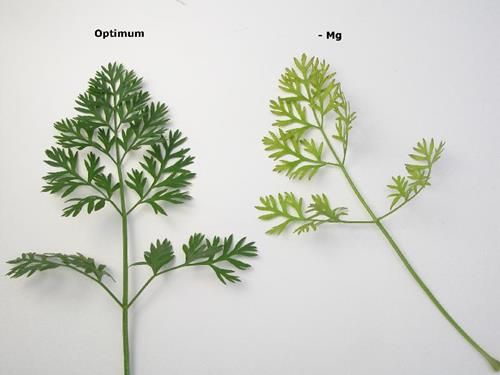
Magnesium deficiency creates a distinctive symptom pattern that's unmistakable once you recognize it. The yellowing of tissue between leaf veins while veins remain green is called interveinal chlorosis.
This pattern appears on older leaves first because magnesium is mobile in the plant and relocates to new growth when supply runs short. You'll notice yellowing or even whitish coloration in the tissue between veins while the main vein network stays green. With severe deficiency, leaf tips develop purple or reddish tints. Spotted necrosis eventually develops on leaf surfaces.
Root growth declines noticeably. Plants show stunted growth and reduced root development compared to adequately nourished neighbors. The overall effect is a plant that clearly needs something, and the leaf pattern tells you exactly what.
Magnesium deficiency typically appears in three soil situations. Sandy soils leach magnesium readily, especially after heavy rainfall. Acidic soils below pH 5.5 bind magnesium into unavailable forms. Soils with excessive potassium applied can create competitive imbalance where magnesium uptake suffers.
Quick correction uses magnesium sulfate, commonly called Epsom salt. Application at 32 kilograms per acre incorporated near plant roots provides rapid improvement. Foliar spray of magnesium sulfate works even faster, showing color improvement within days, though it doesn't replace soil correction. Long term prevention uses dolomite, a slow release calcium magnesium fertilizer that supplies both nutrients over months.
Critical application timing matters. Never apply magnesium and potassium fertilizers together, as potassium directly interferes with magnesium uptake. Apply magnesium first, wait a week, then apply potassium. This small timing change dramatically improves magnesium availability.
Boron Deficiency: Root Cracking and Hollow Cores
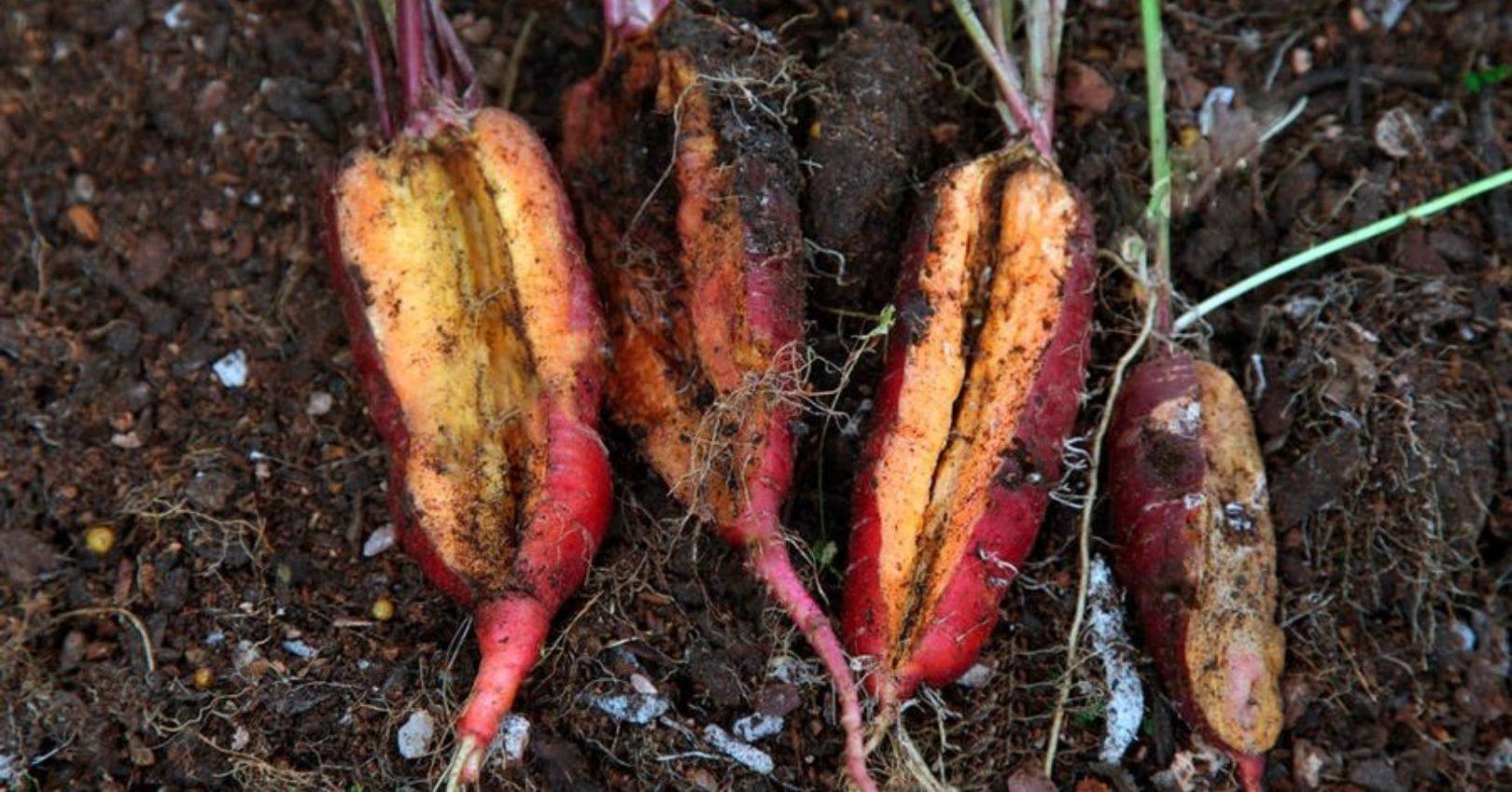
Boron deficiency creates problems that become visible only after harvest, making it dangerously easy to miss until economic damage is done. Boron is essential for cell wall development and growth, particularly in root cells.
The root symptoms are distinctive. Pinhead sized discoloration appears just beneath the carrot skin. As deficiency worsens, roots crack and become brittle. The core may hollow out, and dark discoloration appears in the center of the root. These defects are invisible from above ground. A boron deficient carrot field looks perfectly normal until you pull roots and see internal damage.
Above ground symptoms appear on young leaves. Crinkling of new leaves is an early sign. Growing points may die back. Leaves show reduced size. Older leaves develop orange tinted discoloration. Reduced germination and poor seedling establishment occur if boron shortage develops early in the season.
Boron deficiency occurs primarily in sandy, alkaline, or washed soils where boron availability is lowest. Dry conditions reduce boron uptake because boron moves minimally through the soil and relies on water movement through the plant. Soils above pH 7.5 lock up boron despite it being present.
Correction requires careful application because boron toxicity is easy to create. Borax applied at 4 kilograms per acre incorporated into soil works well. Foliar spray at 1 gram per liter applied to young leaves provides rapid uptake. The critical principle is avoiding combined application of boron with calcium fertilizers or with ammonium based fertilizers, both of which interfere with boron uptake.
Prevention through soil testing before planting identifies boron status. If boron is marginal, lighter applications applied repeatedly work better than single heavy applications. This approach reduces toxicity risk while ensuring boron stays available throughout the season.
Iron, Manganese, and Other Micronutrient Issues
While less common than the major deficiencies, several other micronutrients cause problems in specific soil conditions and regions.
Iron deficiency appears as interveinal chlorosis on young leaves first, the opposite pattern of magnesium deficiency which starts on old leaves. Iron deficiency typically signals acidic soil where iron is present but excess aluminum interferes with uptake. Adjusting soil pH upward reduces iron deficiency risk.
Manganese deficiency creates spotting symptoms on young leaves that resemble magnesium or iron deficiency but with subtle differences in pattern and progression. Both iron and manganese deficiencies are more common in alkaline soils where these micronutrients become locked up despite being present.
Copper and molybdenum deficiencies are rare in carrots but can appear in heavily leached soils or soils deficient in organic matter. Copper deficiency causes leaf wilting and dieback of growing tips. Molybdenum deficiency symptoms resemble nitrogen deficiency but don't respond to nitrogen fertilizer.
Zinc deficiency causes stunted growth and reduced plant vigor without specific leaf coloration patterns. Zinc is essential for enzyme function, so deficiency creates overall performance problems rather than visible specific symptoms.
When multiple micronutrient deficiencies appear simultaneously, soil testing becomes critical to understand what's actually missing. Often, correcting pH or adding organic matter resolves multiple micronutrient problems simultaneously by improving nutrient availability rather than requiring individual micronutrient applications.
How to Diagnose Carrot Nutrient Deficiency in 5 Steps
When you notice something is wrong with your carrot crop, a systematic diagnostic approach prevents guesswork and wrong fixes.
Start by observing where symptoms appear first. Walk through the field and identify whether older leaves or younger leaves show symptoms first. Mobile nutrients create problems visible in older leaves first as the plant moves the nutrient to new growth. Immobile nutrients create problems on young leaves first. This single observation narrows your options significantly.
Next, identify the specific color or pattern change. Pure yellowing suggests nitrogen. Purple or reddish discoloration indicates phosphorus or potassium deficiency. Interveinal yellowing with green veins remaining suggests magnesium or iron. Brown margin scorch indicates potassium. Match the color pattern to your notes from earlier sections.
Assess the root condition by pulling a few plants and examining roots directly. Thin, fibrous roots suggest nitrogen deficiency. Stunted roots suggest multiple possible deficiencies. Cracking or hollow centers indicate boron or calcium problems. Discolored spots or cavities on the root surface indicate calcium deficiency specifically. Root examination often provides the clearest diagnostic clue because root damage is directly visible.
Consider environmental factors that explain the deficiency. Heavy rainfall recently suggests nitrogen leaching in sandy soil. Drought conditions suggest calcium deficiency from blocked water transport. Acidic soils suggest phosphorus or micronutrient problems. Cool spring weather suggests phosphorus or potassium uptake issues despite adequate nutrients in soil.
If you remain uncertain, use professional diagnosis tools. Soil testing from your local agricultural extension provides nutrient status analysis. Tissue analysis tests plant material for nutrient content, telling you exactly what the plant actually contains. Plantlyze AI diagnosis uses plant imaging to identify deficiency patterns from photos, confirming your visual diagnosis and providing treatment recommendations immediately. This is especially valuable when multiple deficiencies might be present or symptoms overlap between different nutrients.
Fixing Deficiencies: Immediate and Long Term Solutions
Nutrient deficiency correction falls into two categories: quick fixes that address immediate symptoms, and long term prevention that stops recurrence.
Quick fixes provide rapid symptom reversal but don't necessarily address the underlying soil problem. Foliar sprays work fastest because the plant absorbs nutrients through leaves within hours. Foliar nitrogen, potassium, or magnesium sulfate shows visible color improvement within days. These sprays prevent further deficiency symptoms while soil applied fertilizers address the root cause. They're especially valuable late in the season when time is short.
Soil applied fertilizers work slower but address the actual deficiency. Liquid or granular applications incorporated into soil or applied as top dressing become available over days to weeks depending on soil conditions and nutrient type. Split applications work better than single heavy applications for mobile nutrients like nitrogen and potassium because they maintain availability throughout the season without excess that causes other problems.
Long term prevention through soil amendment transforms carrot production economics. Annual compost incorporation at 3 inch depth adds both nutrients and organic matter that improves nutrient retention. Organic matter in sandy soils dramatically reduces nutrient leaching. In clay soils, organic matter improves drainage and nutrient availability.
Cover crop integration between carrot plantings builds soil fertility naturally. Legume cover crops add nitrogen through biological fixation. Other cover crops like cereal rye add organic matter. Rotational grazing or incorporate cover crops rather than removing them to build soil organic matter.
Crop rotation prevents depletion of specific nutrients. Different crops have different nutrient demands. A crop rotation that alternates heavy feeders like carrots with less demanding crops allows nutrient recovery. This is especially important in fields with known deficiency history.
Pre plant soil testing before every season identifies nutrient status and guides fertilizer decisions. This costs 20 to 40 dollars per acre but prevents far more costly deficiencies. Testing suggests optimum application rates based on actual soil nutrient levels rather than generic recommendations.
Choosing between organic and conventional approaches depends on farm goals and economics. Organic fertilizers work slower but improve soil structure and organic matter. Conventional synthetic fertilizers work faster and provide more precise nutrient ratios. Many successful farms use hybrid approaches, combining synthetic quick fixes with organic long term soil building.
Diagnose Nutrient Deficiencies Faster with Plantlyze
Unable to diagnose the exact deficiency from visual symptoms alone? Plantlyze uses AI powered plant imaging and diagnosis to identify nutrient deficiencies in seconds. Upload a photo of your carrot foliage or roots, and receive instant identification of the specific nutrient problem, treatment recommendations, and timeline to recovery.
This is especially valuable when multiple deficiencies might be present simultaneously or when symptoms overlap between different nutrients. Rather than spending hours researching similar looking problems, Plantlyze confirms your diagnosis immediately and suggests the most effective treatment for your specific situation. The tool integrates with your management decisions by showing you exactly which nutrient is limiting your yield and how quickly treatment reverses the problem.
For farmers managing large acreages, Plantlyze saves time diagnosing fields systematically. For home gardeners, it removes guesswork from troubleshooting. Visit plantlyze.com and try free diagnosis to see if your carrot problem is actually a nutrient deficiency or something else entirely.
Treatment Timeline and Recovery Expectations
Understanding how quickly different treatments work helps you make decisions about urgency and which approach to use.
Foliar spray applications show visible results within 3 to 7 days. Leaf color improves noticeably. This doesn't mean the deficiency is solved, only that the visible symptom has improved temporarily. Soil correction must accompany foliar spray for lasting fix. Count on foliar spray as emergency symptom management while longer term solutions work.
Liquid fertilizer applied to soil becomes available within 5 to 10 days as soil microbes break down organic compounds and plants begin uptake of available nutrients. Synthetic fertilizers work at the faster end of this range. Organic fertilizers work at the slower end. Root recovery takes longer. Expect roots to normalize in size and quality within 2 to 4 weeks of application if treatment begins early in the season.
Granular fertilizers incorporated into soil or applied as top dressing require 2 to 3 weeks before maximum availability because they dissolve slowly. This slower release means fewer application burns and more steady nutrient availability. The tradeoff is slower symptom reversal.
Soil amendment with organic matter like compost works over months to years. Compost improves nutrient cycling and retention while building soil structure. This long term improvement prevents future deficiencies but doesn't address immediate acute shortage. Combine compost amendment with immediate fertilizer application for best results.
If treatment begins early in the season when plants are small, recovery is usually complete and roots reach normal size. If treatment begins late in the season after weeks of deficiency, roots may never fully recover. This underscores the importance of early detection and quick action.
When to Call for Professional Help
Some situations exceed what farmers can diagnose and fix independently without professional guidance.
Multiple overlapping deficiencies require professional soil and tissue analysis. When two or three deficiencies appear simultaneously, applying wrong fertilizer worsens problems. Professional testing identifies all issues simultaneously and recommends integrated solution rather than sequential fixes.
Deficiency that returns after treatment suggests deeper soil management problem. Recurrent nitrogen deficiency in the same field year after year indicates leaching or organic matter depletion that requires systematic correction. Professional agronomist consultation identifies the root cause and designs long term solution.
Large scale commercial operations justify investment in professional diagnostic services and nutrient management programs. The economics of managing nutrients precisely on hundreds or thousands of acres pays for professional expertise quickly through improved yields and quality.
Environmental stress factors that resemble deficiencies need professional diagnosis to distinguish actual deficiency from temporary stress symptom. Cold soil slowing nutrient uptake looks like deficiency but treatments don't help until soil warms. Drought stress preventing nutrient transport looks like deficiency but additional fertilizer doesn't help until irrigation restores water movement.
Pest or disease problems that mimic nutrient deficiency symptoms need proper identification before treatment. Carrot fly larvae damage roots similarly to potassium deficiency. Leaf spots from fungal disease can resemble magnesium deficiency. Misdiagnosing the problem leads to wasted fertilizer without solving the actual issue.
References
KAU Agri Infotech Portal — https://celkau.in/ecropdoctor/vegetables/carrot/deficiency.php
(Kerala Agricultural University, India — University Extension)Montana State University Extension, Soil Fertility Program — https://landresources.montana.edu/soilfertility/nutrientdeficiency.html
(US Land Grant University Research)University of Connecticut Cooperative Extension — https://homegarden.cahnr.uconn.edu/2024/01/31/nutrientdeficiencyht/
(US Land Grant University Extension)Royal Horticultural Society (RHS) — https://www.rhs.org.uk/prevention-protection/nutrient-deficiencies
(UK Premier Horticultural Research Organization)Iowa State University Extension — https://crops.extension.iastate.edu/files/article/nutrientdeficiency.pdf
(US Land Grant University Research on Field Crops)Soil Wealth — https://soilwealth.com.au/wp-content/uploads/2025/08/Carrot-Nutrient-needs-guide_20250814.pdf
(Australian Agricultural Research Organization)